
Why one dental group finally got the web address it wanted — without sacrificing SEO, reviews, or access to the old site.
When a Maryland dental group originally had its website built, it was given a URL that worked. It was not necessarily bad. It just was not the URL the practice really wanted representing its brand.
Over time, that became more frustrating. The website had already been established, patients knew the old address, business cards had been printed, Google had indexed the site, and the practice had built up online visibility around it.
So when the group transitioned to Innovate Dental Marketing, one of its concerns was simple:
Can we change the website URL without breaking everything we already have?
The answer was yes.
And the key was making the change carefully.
Changing a domain can make practice owners nervous for good reason.
Done incorrectly, it can create problems like:
The dental group did not want to trade one problem for another.
They simply wanted a web address that better represented the practice.
Our job was to make that transition without making patients or search engines feel like the website had disappeared.

Instead of abandoning the old domain, we kept it active and redirected it properly to the new website address.
That meant anyone using the old URL could still reach the practice.
A patient with an old business card?
The link still worked.
An old directory listing?
Still worked.
A bookmark saved years ago?
Still worked.
A Google result or outside website pointing to the old domain?
Still reached the right destination.
Rather than creating a dead end, the old domain became a bridge to the new one.
The transition was not just about forwarding one URL to another.
We also made sure the site’s important pages were mapped correctly so visitors and search engines landed on the appropriate new pages instead of being sent to missing-page errors.
That helped preserve the value the website had already built over time.
The goal was to tell Google:
This practice did not disappear. Its website simply moved.
That distinction matters.
A properly managed domain change can allow a practice to update its branding without throwing away the SEO equity it has spent years building.
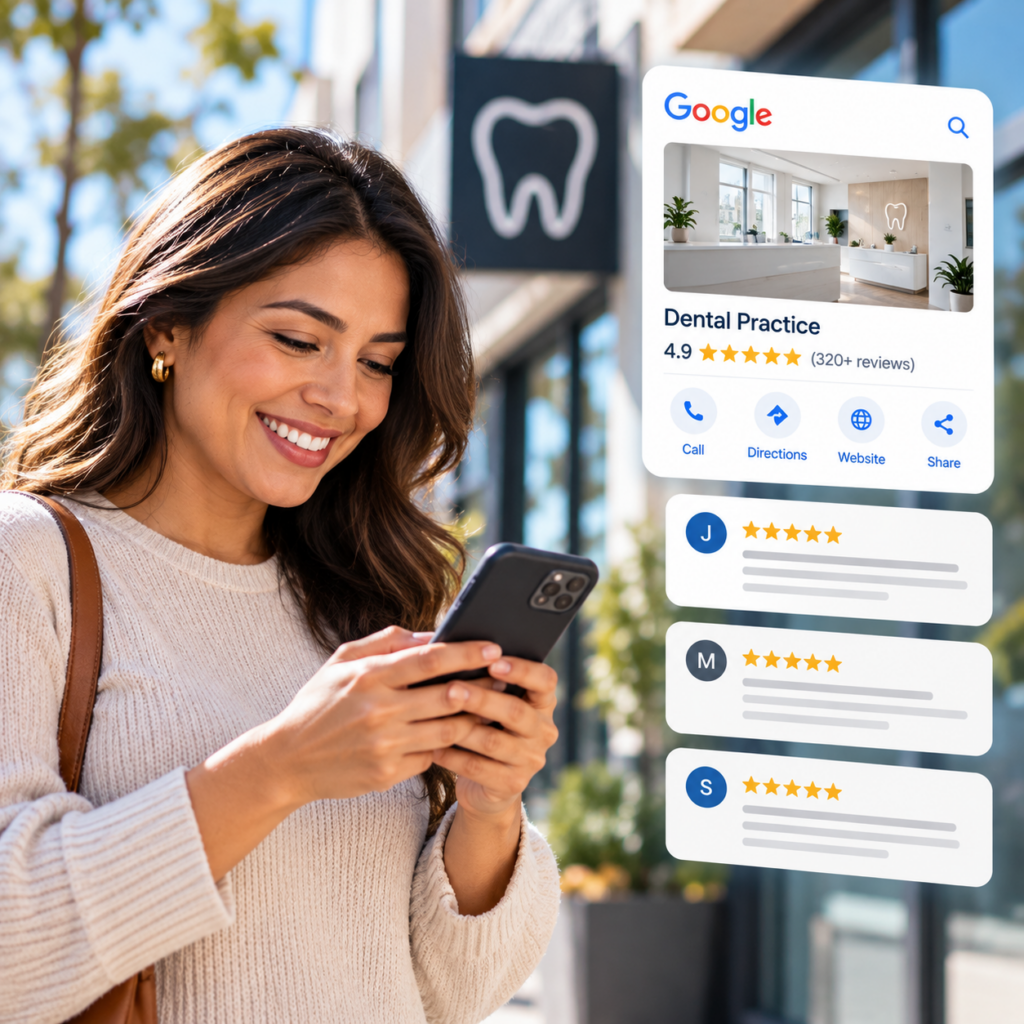
The practice was also concerned about its online reputation.
Changing a website URL does not mean a practice needs to lose its Google reviews or start over with a new Google Business Profile.
The business itself had not changed.
Its patients had not changed.
Its location and reputation had not changed.
We simply updated the digital ecosystem so the practice’s listings and website pointed to the new preferred domain.
The reviews stayed where they belonged.
The Maryland dental group now has a website address that better represents the practice and feels more aligned with how it wants to present itself.
At the same time:
The practice got the branding improvement it wanted without having to sacrifice everything it had already built.
Why it Worked?
The success came from treating the domain change as a migration, not simply a rename. A website URL touches more than the address bar.
It can be connected to search rankings, directories, patient bookmarks, printed marketing materials, Google Business Profile, backlinks, and years of existing traffic.
That is why domain changes should be planned carefully.
The right approach protects the old pathways while creating a cleaner path forward.
Practice owners sometimes assume they are stuck with the domain they were originally given because changing it feels too risky.
That does not have to be the case.
With the right redirects, page mapping, and SEO precautions, a dental practice can move to a better URL without creating unnecessary disruption for patients or search engines.
For this Maryland dental group, the solution was not to start over. It was to preserve what already worked while giving the practice a web address it actually wanted.
Better branding. Same visibility. No dead ends.